Case study · Repair confirmation · Karlsruhe-Durlach
Settled on paper, repaired later – and proven in writing
If you take the payout for the damage and repair the car later, you should get the repair confirmed in writing. A documented case from our office, told in order, with the actual figures from the correspondence.
All figures come from the report and the insurer's settlement letters. Where the documents don't give answers, we say so.
"I'll just take the payout"
After an accident that wasn't their fault, many people choose the fictitious settlement: they take the payout based on the report instead of sending the car straight to the workshop. That's entirely their right. But from the point of view of any insurer down the line, the file still shows damage with no record of whether or how it was repaired.
This is exactly where the repair confirmation comes in: an expert inspects the vehicle after the repair and confirms in writing what was fixed and how long it took. Here's what that looks like in practice, using a real case from our office.
The case at a glance
| Vehicle | Seat Leon 1.5 TSI Xcellence, first registered 07/2019, 79,870 km, one previous owner |
|---|---|
| Date of accident | October 2025 |
| Accident location | Car park on Durlacher Allee, Karlsruhe · Accident recorded by the Karlsruhe-Durlach police station |
| What happened | The car was parked and the driver wasn't present; another car hit it while maneuvering |
| Liable insurer | Verti Versicherung AG |
| Inspection | October 14, 2025, Ingenieurbüro Frieß, Karlsruhe-Durlach |
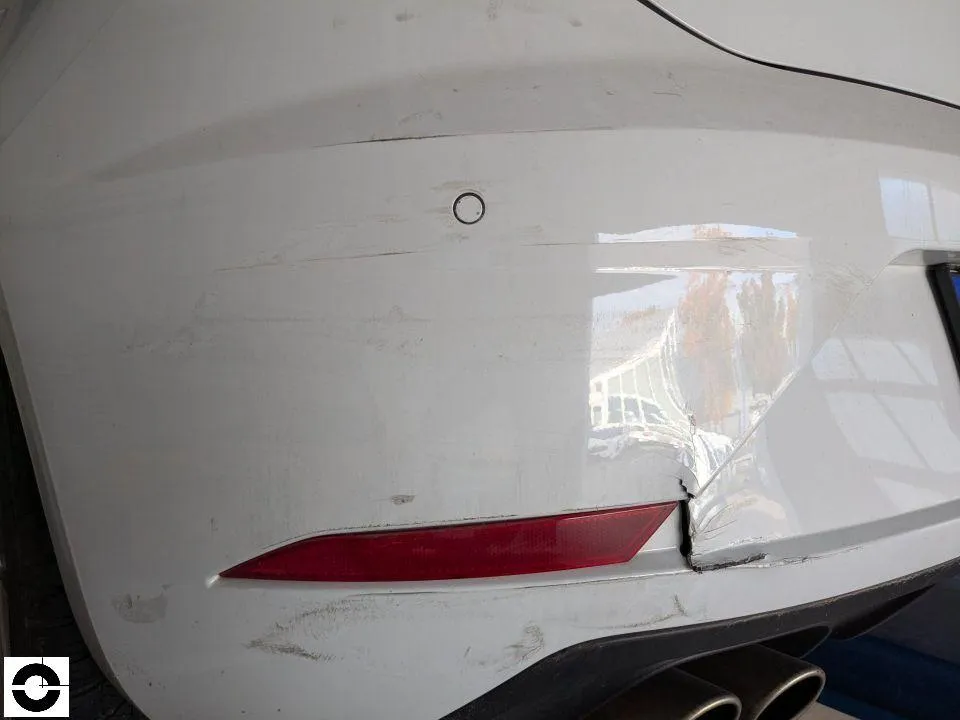
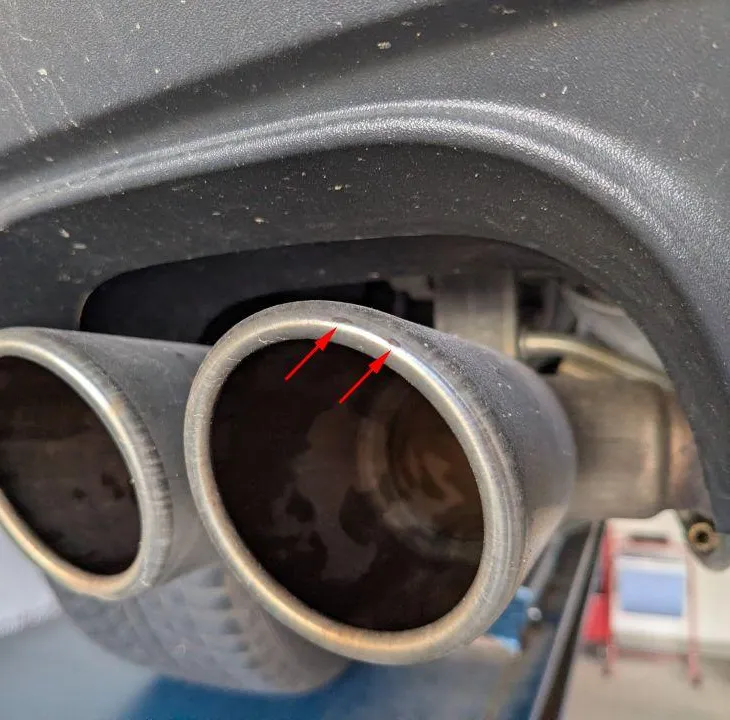
| Damage | Rear bumper broken, bumper reinforcement, left rear parking sensor, rear silencer trim, scratches on the left rear side panel |
| Repair costs per the report | €4,102.68 net · €4,882.19 gross |
| Diminished value | €200.00 |
| Settlement | estimated, based on the report (net) |
| Partial repair | self-performed, 2 working days; re-inspected on 26.05.2026 |
| Repair confirmation | June 2, 2026, sent to the insurer on June 5, 2026 |
| Compensation paid by 30.06.2026 | €5,231.75 (plus €664.26 in legal fees) |
| Still outstanding according to the file | €150.00 in repair costs |
How it unfolded
Oct. 2025
The accident
The vehicle is parked in a car park on Durlacher Allee. Another car backs into the rear while maneuvering. The police record the accident.
Oct. 14, 2025
Inspection in Karlsruhe-Durlach
Inspection at our office, on the lift, including underneath. The same day, the injured party instructs a traffic law firm.
Oct. 15, 2025
The report
Repair costs €4,102.68 net, diminished value €200.00. Settlement based on the report.
Dec. 3, 2025
The settlement
The insurer pays out €5,145.75 in compensation and reports the vehicle data to the insurers' HIS.
until May 2026
DIY partial repair
The bumper and reflector are replaced. Repair time: two working days.
May 26, 2026
Follow-up inspection
We inspect the partially repaired vehicle and document its condition with six photos.
June 2, 2026
Repair confirmation
We confirm in writing what was repaired and how long it took.
June 5, 2026
Confirmation sent to the insurer
The law firm submits the repair confirmation along with the updated claim.
June 30, 2026
Loss of use
The insurer pays €86.00 in loss-of-use compensation for the two repair days.
October 2025
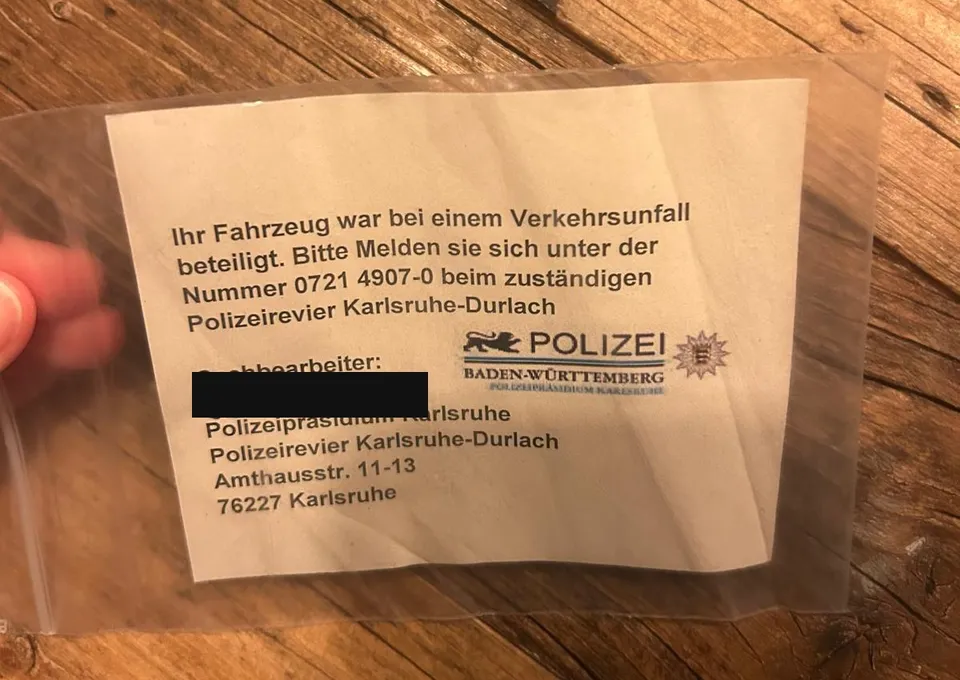
A note left on a parked car
The driver wasn't there when the accident happened. Her car was parked, and when she came back, she found a note from the Karlsruhe-Durlach police station asking her to get in touch. According to the accident report later sent to the insurer, another car backed into the parked vehicle while maneuvering, and the driver responsible was identified. Shared liability was never an issue in this case.
October 14 and 15, 2025
What the report stated
Three days after the accident, the Seat was up on the lift in our Karlsruhe-Durlach office. From the outside, it looked like just a torn bumper. From underneath, there was more to see: impact damage to the bumper bracket, the rear muffler trim, and the left rear parking sensor, plus scratches along the side panel.
The owner wanted to settle based on the report alone – on a fictitious basis. That meant only the net amounts would be paid out, not the VAT of €779.51. VAT is only due if the car is actually repaired and an invoice is submitted.
- Repair costs: €4,102.68 net
- Diminished value: €200.00
- Loss-of-use compensation: up to €50.00 per calendar day
- Repair time: approximately 3 to 4 working days
- Road safety: not affected by the damage
3 December 2025
The settlement – and a report to the HIS
Seven weeks after the accident, the insurer settled: €5,145.75 in compensation plus €664.26 in legal fees. Diminished value, the expert's fee, and the flat-rate costs were all paid. For repair costs, they applied €3,952.68 "according to their review report" – €150.00 less than stated in our report. The difference matches exactly the transport costs calculated in our report, but we don't have their review report itself. Based on the file, this amount remains open.
The same letter contains a paragraph most claimants overlook: the insurer reported vehicle data, "such as the license plate and/or vehicle identification number," to the insurers' Hinweis- und Informationssystem (HIS) – a shared information and reference system.
In their own words
What the letter from 3 December 2025 says
| Repair costs per audit report, net | €3,952.68 |
|---|---|
| + Diminished value | €200.00 |
| + Expert's fees | €968.07 |
| + Flat-rate expenses | €25.00 |
| Total / compensation claim | €5,145.75 |
| + Legal costs and fees | €664.26 |
| Amount paid | €5,810.01 |
| HIS notice (abridged) | "… data on your client's vehicle, such as the registration number and/or vehicle identification number, has been reported to the Hinweis- und Informationssystem (HIS) …" |
Stated purpose: risk assessment for insurance applications, fact-finding in insurance claims, cross-referencing past claims, and combating insurance fraud. The data could be retrieved "at a later date, if an insurance application is made for this vehicle or a claim is reported to an insurer."
What the HIS entry means later on
HIS is a shared database run by the German insurance industry, operated today by Besurance HIS GmbH in Wiesbaden (the letter still uses the earlier name, informa HIS GmbH). If this Seat is involved in another accident, the insurer handling that claim can see that a damage was already reported. According to the insurance industry, an HIS entry alone doesn't lead to a claim being rejected, but it does trigger closer scrutiny. What matters then is what you can prove: was the earlier damage repaired, and if so, which part? Requesting a self-disclosure of what's stored about your vehicle is free of charge for registered keepers and owners.
In detail: HIS entry, prior damage, and selling after a fictitious settlement
Spring 2026
A partial repair, done independently
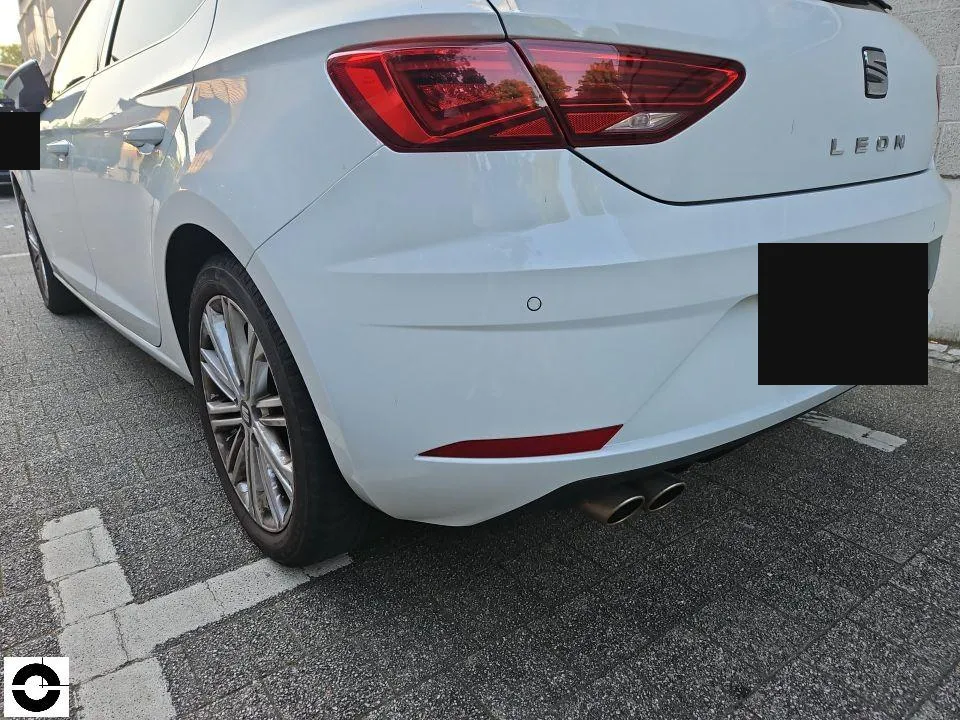
Months later, the keeper had the car repaired—though not completely. The rear bumper and the rear left reflector were replaced, over two working days. Under fictitious settlement, that's entirely legitimate: the money belongs to the injured party, and what they do with it is their own business. No workshop invoice needs to be shown when settling fictitiously. But without one, there's also no proof that any repair actually took place.
26 May to 5 June 2026
The repair confirmation
On 26 May 2026 we re-inspected the vehicle, and on 2 June 2026 we issued the repair confirmation. In plain terms, it states:
"The vehicle was re-inspected on 26.05.2026. It was found that the vehicle has since been partially repaired. The repair took 2 working days."
This includes the work carried out – rear bumper replaced, rear left reflector replaced – along with six photos of the repaired vehicle. On June 5, 2026, the law firm submitted the confirmation to the insurer, which had previously reported the damage to the HIS. This means there is now expert evidence on file showing which part of the reported damage has been repaired. Based on our experience, insurers update the HIS entry as soon as they receive such a confirmation, noting the partial repair. Whether this has already happened in this case isn't clear from the documents.
Just as important is what's *not* in the confirmation: the side panel, bumper reinforcement, lower bumper trim, parking sensor, and the trim around the rear muffler are not listed as repaired. If damage occurs in this area later on, the vehicle owner should expect these items to be treated as pre-existing damage.
Rule of thumb: if you settle fictitiously and then repair, get the repair confirmed
With a fictitious settlement, there's no workshop invoice on file. The repair confirmation then serves as proof of whether—and what—was repaired, for the next claim and for a future sale.
And when it comes to selling?
Buyers can't query HIS themselves; self-disclosure is only available to keepers, owners, and policyholders. So when selling, it comes down to what you disclose about the accident damage yourself and what you can prove. A repair confirmation shows the buyer exactly which damage was fixed.
If you're aware of accident damage beyond a minor scratch, you must disclose it when selling, even without being asked, even if it was professionally repaired (BGH, 03.03.1982 – VIII ZR 78/81; BGH, 10.10.2007 – VIII ZR 330/06). The repair confirmation doesn't replace this disclosure, not even for the parts that weren't repaired.
Side effect
€86.00 loss of use compensation
The repair confirmation also made it possible to settle the loss-of-use claim, which had deliberately been left open in the initial claim notification ("amount to follow").
| Loss of use per the amended claim (05.06.2026) | 2 days × €43.00 = €86.00 |
|---|---|
| paid on 30.06.2026 | €86.00 |
The law firm applied €43.00 per day; our report states €50.00 as the maximum value and notes that, according to prevailing case law, vehicles over five years old are placed one class lower. Whether the €43.00 is based precisely on that isn't clear from the correspondence. The two days actually spent on repairs were billed, not the three to four days forecast in the report.
Case law
What this is based on
| BGH, 24.01.2017 · VI ZR 146/16 | If you settle fictitiously, the cost of a repair confirmation "on its own" won't be reimbursed. It can be different if the confirmation is legally required for the settlement of the claim – the BGH explicitly mentions claiming an additional loss of use. |
|---|---|
| BGH, 03.03.1982 · VIII ZR 78/81 | Known accident damage must be disclosed unprompted when selling; only minor damage such as very slight surface paint defects is exempt. |
| BGH, 10.10.2007 · VIII ZR 330/06 | Accident damage that goes beyond a minor defect constitutes a material defect, even if it was professionally repaired. |
We are vehicle experts, not lawyers: this overview does not replace individual legal advice.
What this means for our client
| Compensation, first settlement (03.12.2025) | €5,145.75 |
|---|---|
| Loss of use after repair confirmation (30.06.2026) | €86.00 |
| Total compensation | €5,231.75 |
| Legal fees, covered by the insurer | €664.26 |
| Still open based on the file | €150.00 |
| Repair documented | Rear bumper, rear left reflector |
For context
What we can document, and what we can't
What's documented: the payments from December 3, 2025 and June 30, 2026, the insurer's HIS report, and the repair confirmation sent to the insurer on June 5, 2026. What's not documented: whether the insurer updated the HIS entry after receiving the confirmation. Only the owner can find out what's currently listed in HIS for this vehicle, by requesting a self-disclosure.
The €150.00 was still being claimed in the amended claim of June 5, 2026. We have no record of any payment covering it.
Conclusion
What you can take away from this case
If you settle on an estimate basis in or around Karlsruhe and later have the car repaired, it's worth having an expert confirm the repair. In this case, the insurer that reported the claim to HIS then had proof of the repaired part on file — and the €86.00 loss-of-use payment came along as a side benefit.
- Fiktive (estimate-based) settlement can trigger an HIS report. Check the relevant paragraph in your settlement letter.
- Have a DIY repair confirmed. Without a workshop invoice, it otherwise isn't documented.
- A partial repair only documents the part that was repaired. Anything missing from the confirmation can later be treated as pre-existing damage.
- Keep your loss-of-use claim open. The note "amount to follow" in the initial claim made it possible to settle this eight months later.
- Check "per inspection report" line by line. Here, €150.00 went missing between the report and the settlement.
The author
Who handled this case

Sascha Frieß
Owner · Expert appraiser
Business engineer (M.Sc., KIT) and managing partner. Before joining the office, he spent eight years in automotive consulting at Porsche Consulting, focusing on aftersales. Today, he handles damage and value assessments as well as claims settlement with insurers.
- M.Sc. in Industrial Engineering (KIT)
- Certified vehicle appraiser
- Damage and value assessment
- Claims settlement with insurers
The inspection, report, follow-up inspection, and repair confirmation in this case were all handled by him.
More about Sascha FrießFrequently asked questions
Repair confirmation, fictitious settlement, and the HIS
What is a repair confirmation?
Why do I need a repair confirmation after settling on an estimate basis?
Will my car be reported to HIS after an estimate-based settlement?
Is the HIS entry deleted after the repair?
So the entry usually isn't deleted, but it is updated: based on our experience, insurers note a proven (partial) repair in the HIS as soon as they receive the repair confirmation.
Can I only partially repair the car after the payout?
Do I get loss-of-use compensation with fictitious settlement?
Who pays for the repair confirmation?
Settled your claim on a fictitious basis and now having the repairs done?
We'll confirm the repair for you.
Mon–Sat 08:00–20:00